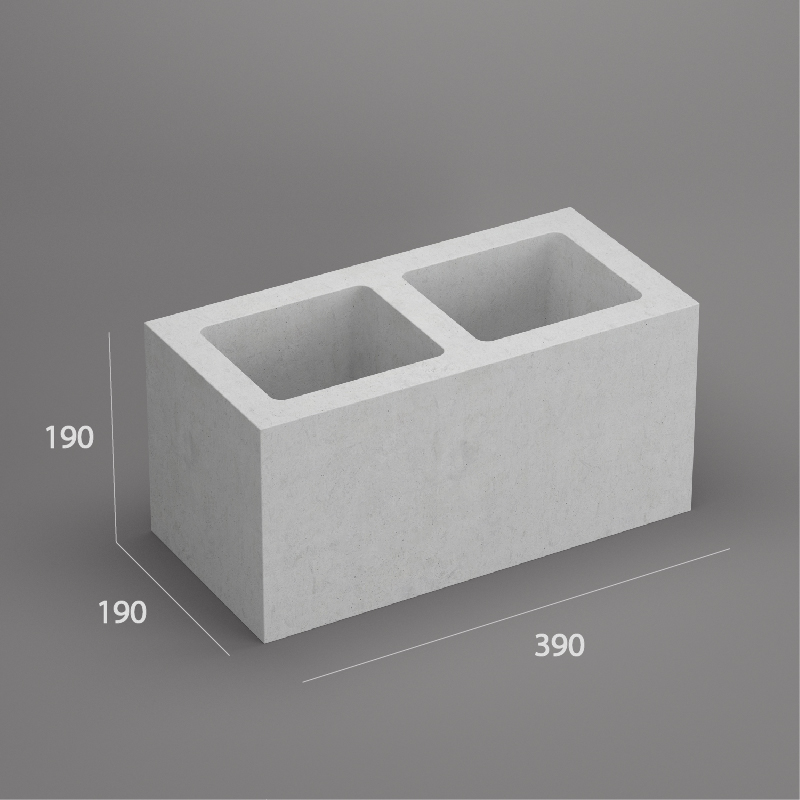
PBM Hollow Blocks are precast concrete masonry units (CMU) for structural and non-structural wall construction. The series spans 14 modules across six widths : 70mm, 90mm, 100mm, 115mm, 140mm, and 190mm – supporting partition walls, load-bearing walls, boundary walls, lintels, and corner returns within a single coordinated module system.
Standard blocks share a 390 × 190mm face dimension, supporting a 400 × 200mm coursing module with 10mm joints. Half blocks, L-shape corner units, and U-shape channel units complete the system, allowing wall corners, openings, and bond beams to be constructed without cutting standard blocks on site.
Load-bearing structural walls (140mm and 190mm widths, with reinforcement and concrete fill where required)
Non-load-bearing partition walls (70mm to 115mm widths)
Internal walls in commercial, residential, and institutional buildings
Industrial, warehouse, and factory walls
Sound-attenuating wall assemblies
Key Features
Six standard widths from 70mm to 190mm covering partition and structural use cases
Hollow cavity construction reduces unit weight and accommodates reinforcement bar plus concrete fill where structural capacity is required
L-shape units for clean wall corners without on-site cutting
U-shape channel units for lintels and bond beams without separate formwork
Manufactured under controlled precast conditions for dimensional consistency
FAQ —
What's the difference between a full block (.01) and a half block (.05)?
The full block measures 390 × 190mm on the face; the half block measures 190 × 190mm. Half blocks are used to finish courses, complete corners, and infill openings without cutting full blocks. Both share the same width (e.g., 90.01 and 90.05 are both 90mm wide).
When should I use an L-shape block?
L-shape blocks (100.01 L, 115.01 L) are used to form clean wall corners without cutting or notching standard blocks. They produce a structurally sound corner with consistent bond pattern and reduce on-site cutting waste.
What's a U-shape block used for?
U-shape channel blocks (140.01 (U), 190.01 (U)) carry a continuous channel along the top face. They are used to construct lintels above door and window openings and to form bond beams (continuous reinforced concrete beams within the wall course) without separate formwork.
Which width do I need for a load-bearing wall?
Generally, 140mm and 190mm widths support load-bearing applications when reinforced and filled appropriately. 70mm to 115mm widths are typically specified for non-load-bearing partition walls. Final selection depends on structural calculations – consult the project structural engineer.
Do I need to fill the cavities with concrete?
Cavity fill is required where the wall is reinforced for structural load, at jambs and reveals of openings, and at lintels and bond beams. For non-load-bearing partition walls, cavity fill is generally not required.
What's the difference between PBM Hollow Block and GenBlock?
PBM Hollow Block is the traditional precast concrete masonry unit with two large cavities, used across structural and partition applications including load-bearing walls and bond beams. GenBlock is PBM’s improved partition block with multiple smaller cavities, optimised for non-load-bearing internal walls – featuring wider face dimensions (115mm), flat surfaces for skim coat, and cavities sized to accommodate utilities piping. Choose Hollow Block for structural and traditional applications; GenBlock for non-load-bearing internal partitions where ease of installation and finishing is the priority.